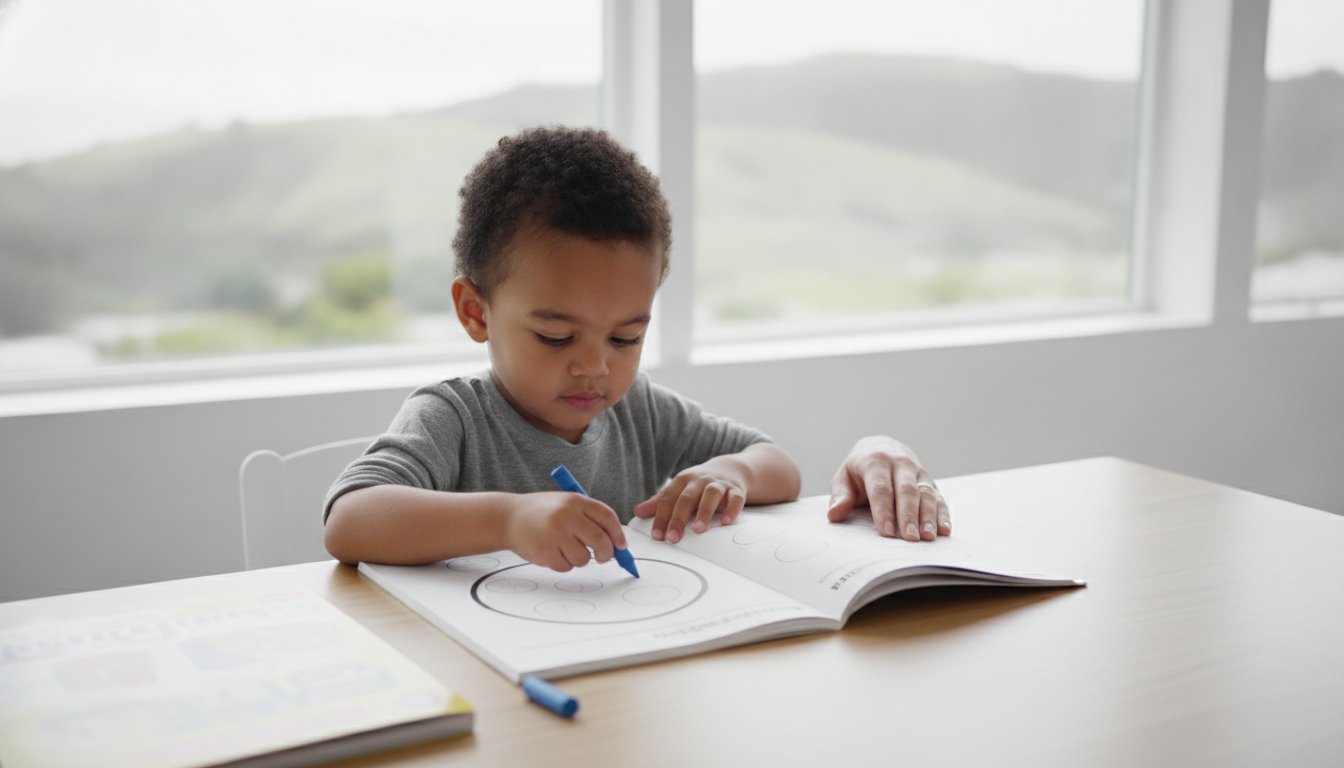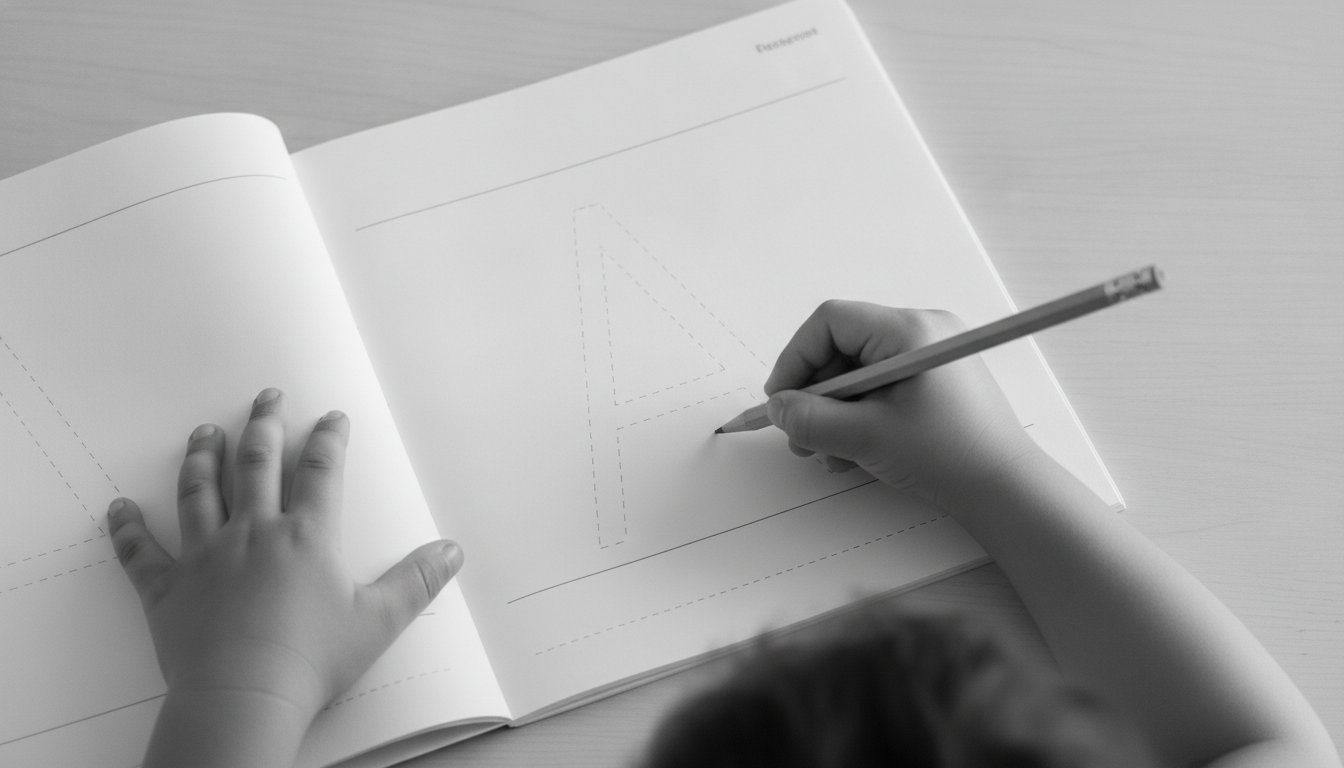
Handwriting is not merely a mechanical repetition of shapes. It is a sensory-motor dialogue that anchors a child's cognitive stability, personal expression, and academic confidence. Selecting the right homeschool handwriting workbooks is a choice that influences how a child maps their thoughts onto the physical world. When a young learner picks up a pencil, they're doing more than copying lines; they're building the bridge between their imagination and the page.
It's understandable if you feel overwhelmed by the volume of curriculum choices available in 2026. You might see your child resist repetitive tracing tasks or worry that fine motor delays are holding them back from their potential. We believe these tools should serve as intentional mentors rather than sources of frustration. This guide will show you how to choose resources that transform daily practice into a journey of developmental growth and creative assurance. We'll examine how to foster legibility, establish a peaceful morning routine, and build the strong motor foundations necessary for a lifetime of clear communication.
Key Takeaways
- Recognize handwriting as a vital cognitive anchor that strengthens the hand-brain connection and supports long-term literacy in a digital world.
- Identify the critical milestones of fine motor development, focusing on the essential triad of grip, posture, and paper positioning.
- Compare traditional and modern instructional methods to find the homeschool handwriting workbooks that best align with your family's educational philosophy.
- Establish a peaceful and productive daily routine by creating a dedicated 'Journey Space' that integrates writing into functional, everyday activities.
- Explore how intentional tools like 'Little Hands, Big Letters' transform simple tracing into a foundation for lasting legibility and creative assurance.
The Role of Handwriting in a Modern Homeschool Curriculum
Handwriting serves as a vital cognitive anchor. In a world saturated with digital interfaces, the physical act of pen on paper provides a tactile grounding that screens cannot replicate. It's a fundamental bridge between abstract thought and concrete reality. When children use homeschool handwriting workbooks, they aren't just practicing letters. They are engaging in a complex neurological process that strengthens literacy, memory, and spatial awareness. This process requires a specific kind of internal silence. It demands focus, encourages patience, and rewards persistence. By slowing down to form a single character, a child learns to value the effort behind the output.
We view penmanship as a journey of discovery rather than a mechanical chore. This journey begins with the very first grip of a pencil and evolves into a sophisticated tool for self-expression. The hand-brain connection is powerful. Research consistently shows that the brain's motor pathways are more deeply engaged during manual writing than during typing. This engagement fosters a deeper understanding of language structure. It is a sensory experience that combines sight, touch, and movement to create a lasting mental map of the written word.
Why Penmanship Still Matters in 2026
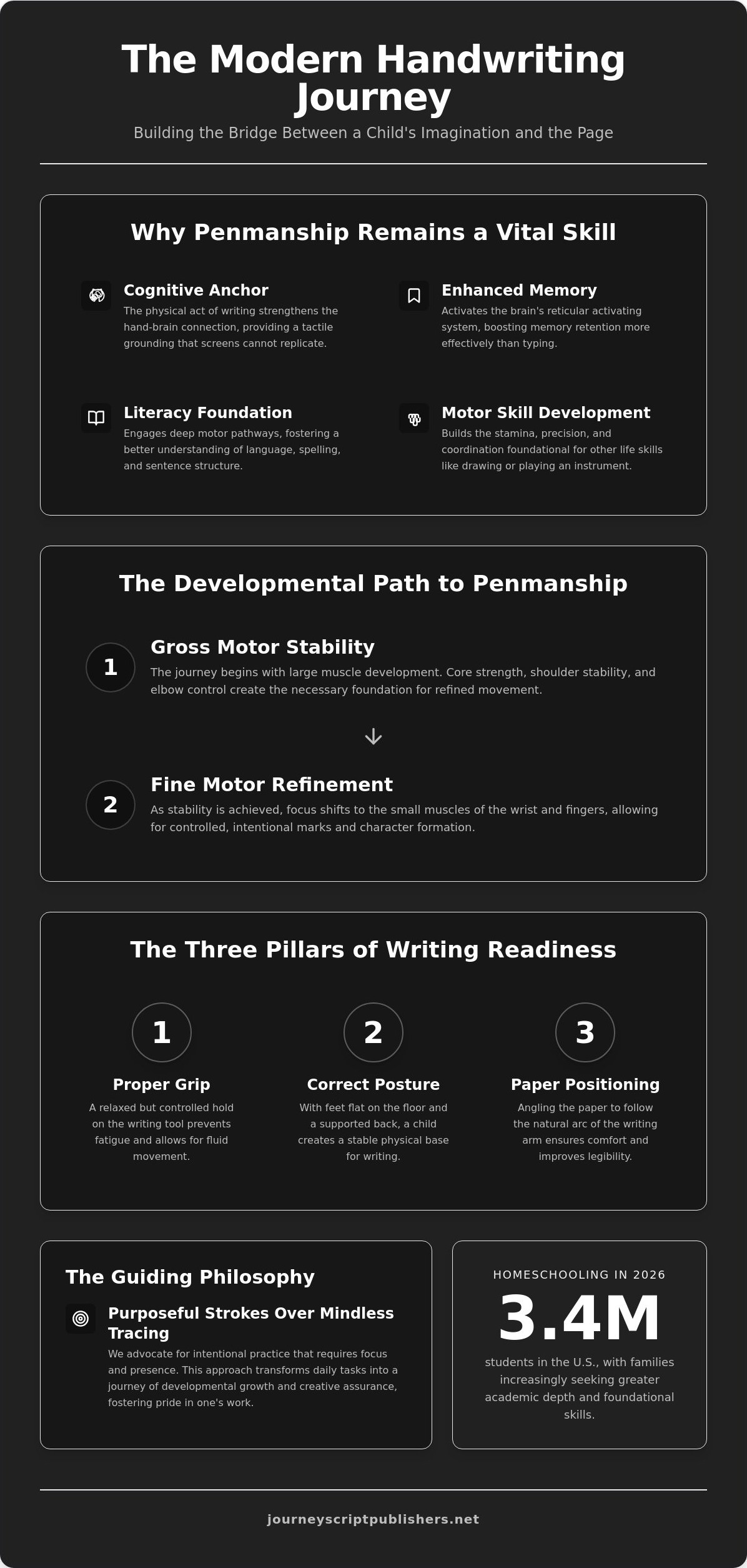
Writing by hand remains essential because it activates the brain's reticular activating system. This helps with memory retention more effectively than digital input. In 2026, as the number of homeschooled students in the United States has reached approximately 3.4 million, families are increasingly seeking academic depth. A child's signature is a mark of their developing identity. It is unique, personal, and permanent. Beyond identity, the intricate movements required for Handwriting styles and development stimulate neural pathways that support broader fine motor skills. These pathways are foundational for other tasks like drawing, playing instruments, or scientific observation. Physical writing builds stamina, precision, and coordination.
Intentionality: The Journeyscript Philosophy
Our philosophy centers on moving beyond mindless, repetitive tracing. We advocate for purposeful strokes that require the child to be present in the moment. This requires a quiet space for learning, a steady hand, and a supportive guide. By choosing high-quality homeschool handwriting workbooks, you provide your child with a mentor on the page. We seek a balance of professional authority and supportive warmth. This approach ensures that the child feels capable, challenged, and encouraged. We believe in creating tools that respect the child's developmental pace while providing a clear path toward mastery. It's about cultivating a sense of pride in one's work, a respect for tradition, and a readiness for the future.
Understanding the Developmental Stages of Fine Motor Control
Handwriting is a physiological milestone that requires the synchronization of the eye, the mind, and the small muscles of the hand. Before a child can master the precision required by homeschool handwriting workbooks, they must first develop gross motor stability. This involves core strength, shoulder stability, and elbow control. As these large muscle groups stabilize, the focus shifts to the refined movements of the wrist and fingers. This progression is not a race; it is a steady unfolding of physical capability that allows a child to move from big, bold scribbles to controlled, intentional marks.
Identifying "writing readiness" in toddlers and preschoolers is a matter of observation. You might notice your child crossing the midline while playing, showing an interest in small-object manipulation, or attempting to mimic the lines they see in the world around them. Proper grip, posture, and paper positioning are the three pillars of this stage. A child's feet should be flat, their back supported, and their paper angled to follow the natural arc of their arm. Understanding The Role of Handwriting in Literacy clarifies why these physical habits are so vital. They aren't just about neatness; they're about creating a comfortable, sustainable path for cognitive expression.
From Coloring to Character Formation
Coloring is the quiet precursor to composition. In "Little Hands, Big Colors," the focus remains on building the foundational hand strength needed for the eventual transition to homeschool handwriting workbooks. Coloring within boundaries teaches spatial judgment, pressure control, and boundary-awareness. These are the same skills required to keep letters on a baseline. By integrating color recognition into these early exercises, we keep the child's visual senses engaged, ensuring that the work feels like a creative discovery rather than a repetitive drill.
Sensory-Motor Integration in the Early Years
The tactile experience of the page influences how a child perceives the task of writing. The texture of the paper, the resistance of the lead, and the rhythm of the stroke all contribute to sensory-motor integration. We teach the child to feel the movement: the steady pull down, the light curve around, and the purposeful lift. Common frustrations like hand fatigue or an inefficient grip often indicate that the hand muscles need more preparatory play. Building these foundations requires patience and the right tools. You can explore our curated collection of developmental workbooks to find the perfect starting point for your learner's specific stage of growth.
Comparing Homeschool Handwriting Methods and Workbook Styles
Choosing the right method is a foundational decision. It shapes how your child perceives the written word for years to come. Families often weigh three primary styles: the geometric simplicity of Ball-and-Stick, the rhythmic flow of Slant Print, or the fluid connectivity of Cursive-First. Each approach offers distinct advantages. Ball-and-stick is often praised for its accessibility. Slant print prepares the hand for future transitions. Cursive-first is frequently chosen to minimize letter reversals and foster a sophisticated motor memory. Your choice should reflect your child's temperament, your educational philosophy, and your long-term goals.
The physical layout of homeschool handwriting workbooks plays a silent but significant role in a child's success. Cluttered pages with excessive illustrations can lead to sensory overwhelm. We favor clean, uncluttered designs that prioritize white space and clear baselines. This simplicity allows the learner to focus entirely on the stroke. When evaluating the "Little Hands" series against traditional curricula, the difference lies in the intention. While some programs focus on high-volume drills, our approach emphasizes quality, engagement, and developmental readiness. It's about making every mark count.
Deciding between "Open-and-Go" physical workbooks and digital downloads involves a balance of convenience and flexibility. Physical workbooks provide a tangible sense of progress. They offer a durable, high-quality surface that respects the sensory needs of young writers. Conversely, digital options allow for infinite practice. Many parents find that a hybrid approach works best. They use a core workbook for primary instruction and supplemental sheets for targeted reinforcement. This ensures that the physical experience of writing remains central to the curriculum.
Traditional vs. Simplified Cursive
The debate over cursive's place in the modern home is ongoing. Many families now opt for simplified cursive forms to reduce transition frustration. These methods strip away unnecessary flourishes, focusing instead on the essential connections between letters. It's a practical compromise. It honors the tradition of fluid writing while acknowledging the need for clarity and speed in a modern context. Selecting a method that aligns with your values ensures that handwriting remains a source of pride rather than a point of conflict.
The Value of Supplemental Digital Materials
Technology can be a supportive partner in a traditional curriculum. We offer Downloadable Bonus Materials to reinforce the lessons found in our physical books. These resources are particularly useful for creating a hybrid learning environment in your San Bruno home. You might use a printable worksheet to master a particularly tricky letter or to provide extra practice on a rainy afternoon. This flexibility allows you to tailor the pace of the journey to your child's specific needs. It ensures that the foundations are solid, reliable, and enduring before moving forward.
Best Practices for Daily Handwriting Sessions in the Peninsula
Creating a successful routine begins with the environment. We suggest establishing a dedicated "Journey Space" in your home. This area should be quiet, well-lit, and free from the distractions of digital devices. It serves as a physical cue that it is time for focused, intentional work. In the high-pressure environment of the San Francisco Peninsula, finding this pocket of stillness is essential. It allows the child to transition from the high-energy activities of the day into a state of calm concentration. A steady, invitational approach helps manage the "San Francisco Pace" by prioritizing depth over speed.
Integrating penmanship into daily life makes the skill feel functional and relevant. Encourage your child to participate in real-world writing tasks. They might help with grocery lists, write thank-you letters to grandparents, or create labels for their toy bins. This practice moves the lessons from homeschool handwriting workbooks into the realm of meaningful communication. It demonstrates that writing is not just a school subject but a tool for living. By making writing a natural part of your household rhythm, you reduce resistance and build creative confidence.
The Rhythmic Routine: Time and Consistency
Short, frequent sessions are more effective than long, infrequent drills. We recommend the 10-minute rule. This brief window respects a young child's attention span and prevents hand fatigue. Finding your child's peak focus time is equally important. For many, this is the fresh clarity of the morning. For others, it might be a quiet moment after lunch. We utilize a tripartite approach to structure these sessions: Review, Practice, and Create. This cycle provides stability and ensures that every session feels complete and productive.
Local Resources for Homeschoolers in San Mateo County
The Peninsula offers a wealth of community support for families. Connecting with local homeschool co-ops in Redwood City and Palo Alto provides opportunities for social learning and shared resources. Our own roots are in San Bruno, where local educational stores offer the tactile tools needed for a successful journey. You can also turn local landmarks into writing prompts. A field trip to the Filoli Historic House or a walk through a San Mateo park can inspire a short descriptive sentence or a sketch. These local connections ground the learning process in the child's own community.
To support your daily practice, we offer intentional workbooks and resources designed to grow with your child. These tools provide the structure needed to maintain a steady pace in a busy world.
Cultivating Confidence with Journeyscript Publishers’ Workbooks
At Journeyscript Publishers, we view ourselves as quiet partners in your child's early educational experiences. We don't just provide homeschool handwriting workbooks; we offer a structured path toward mastery. Our mission is to support the long-term growth of every young learner through intentionality and grounded purpose. We believe that the tools a child uses should be foundational mentors that respect their developmental pace while providing a clear sense of direction.
This journey often begins with "Little Hands, Big Colors." This resource is designed to prepare the hand for the pen by focusing on control, pressure, and boundary-awareness. By mastering these foundational movements, children build the muscular endurance needed for more complex tasks. It's a gentle introduction that transforms simple coloring into a purposeful exercise in fine motor strength. This preparation ensures that when a child finally picks up a pencil to form letters, their hand is steady, capable, and ready.
To extend the value of our physical books, we provide Downloadable Bonus Materials. These resources allow you to tailor the learning experience to your child's specific needs. Whether you need extra practice on a difficult curve or want to integrate more creative prompts, these materials act as a bridge between the workbook and daily life. They offer a way to reinforce lessons without the pressure of a rigid schedule, maintaining the steady, invitational rhythm we advocate for in every home.
The Little Hands, Big Letters Experience
The transition to character formation requires a shift in focus. "Little Hands, Big Letters" provides the clean, uncluttered rhythms necessary for letter clarity. Each page is designed to minimize distractions, allowing the learner to focus on the essential geometry of the alphabet. We engage toddlers with purposeful, grounded tracing exercises that move beyond mindless repetition. This approach builds a solid foundation for kindergarten readiness by fostering a child's confidence, legibility, and creative assurance. It's about making every stroke a meaningful step toward communication.
A Supportive Mentor in Every Page
Our workbooks are curated for durability and practical use. They are designed to withstand the enthusiastic grip of a young learner while providing a high-quality surface that respects their sensory needs. The progression is methodical. We guide the child from broad, experimental strokes to sophisticated, personal penmanship. This steady evolution ensures that the child feels successful at every stage. We're here to provide the reliable knowledge and steady support you need to make handwriting a peaceful part of your morning routine.
Explore our collection of educational workbooks for young children to find the right companion for your learner's next steps. We're honored to be a part of your ongoing journey of discovery and improvement.
Embarking on a Lifetime of Clear Expression
Handwriting is a bridge between internal thought and external reality. By understanding the developmental journey of fine motor control and selecting the right homeschool handwriting workbooks, you provide your child with a foundational tool for self-assurance. We've explored how a dedicated space, a rhythmic routine, and a supportive method can transform a simple morning task into a meaningful dialogue between the hand and the mind. It's a process that values patience, precision, and personal growth.
As an independent publisher based in San Bruno, we're committed to providing mentor-led content that respects the child's natural pace. Our approach integrates letters, colors, and creativity to ensure every stroke is a step toward mastery. With our supportive guides and Downloadable Bonus Materials, you have a partner dedicated to your family's educational success. We're here to help you cultivate a quiet space for learning and reflection that lasts well beyond the early years.
Begin your child's purposeful writing journey today
Your commitment to intentional penmanship today builds the clarity and confidence they'll carry for a lifetime. Every letter formed is a new discovery on their path to becoming a capable communicator.
Frequently Asked Questions
What is the best age to start using a handwriting workbook?
Most children are ready to begin using homeschool handwriting workbooks between the ages of three and five. You'll know they are ready when they show interest in drawing, can cross the body's midline, and demonstrate basic hand-eye coordination. We suggest starting with preparatory play and coloring to build foundational strength. It's about respecting the child's pace, observing their physical readiness, and providing the right tools at the right time.
Should I teach print or cursive first in my homeschool?
The choice between print and cursive depends on your family's specific educational values and goals. Traditional print is often seen as more accessible for early readers. Cursive-first methods are praised for reducing letter reversals and building fluid motor memory. Many modern homeschoolers opt for simplified cursive forms. This approach honors tradition, ensures legibility, and minimizes future transition frustration. Choose the method that feels most natural for your child's temperament.
How do I help a child who hates writing and tracing?
Transitioning away from resistance requires a shift from mechanical drills to purposeful engagement. Keep sessions brief by following the 10-minute rule to prevent fatigue and frustration. Use high-quality homeschool handwriting workbooks that prioritize clean, uncluttered pages to reduce sensory overwhelm. Focus on meaningful applications like writing thank-you notes, labeling toy bins, or helping with grocery lists. When a child sees writing as a tool for communication, their creative confidence naturally grows.
Are digital handwriting worksheets as effective as physical workbooks?
Physical workbooks offer superior sensory-motor grounding compared to digital alternatives. The resistance of the pencil against the paper builds necessary hand strength, coordination, and tactile awareness. Digital worksheets can serve as helpful supplements for extra practice or on-the-go learning. However, the physical act of writing on paper anchors cognitive stability more effectively. We believe in the long-term value of a tangible, durable workbook that tracks a child's progress through their developmental journey.
How much time should we spend on handwriting practice each day?
Aim for 10 to 15 minutes of daily practice to maintain steady progress without causing burnout. Consistency is far more impactful than the total number of minutes spent at the table. We recommend a tripartite structure: review a previous letter, practice a new stroke, and create a short word or drawing. This rhythm keeps the mind engaged, prevents hand fatigue, and ensures the morning routine remains peaceful. Short bursts of focus lead to lasting mastery.
What makes the 'Little Hands' series different from other workbooks?
Our series stands out through its commitment to intentionality, clarity, and developmental readiness. Unlike curricula that focus on high-volume repetition, we prioritize purposeful strokes and clean rhythms. We curate our content to be a supportive mentor on every page, ensuring the design avoids sensory overwhelm. Our workbooks focus on the meaningful impact of the written word. This helps children build creative assurance, foundational motor skills, and a genuine love for penmanship.
Can I find Journeyscript workbooks locally in the San Francisco Bay Area?
Journeyscript Publishers is an independent house based in San Bruno, serving the entire San Francisco Bay Area. While our primary distribution is online, we are deeply rooted in the local Peninsula community. We support homeschool co-ops in Redwood City, Palo Alto, and surrounding areas through community engagement and shared resources. Our mission is to provide practical tools and engaging stories to families throughout the region. We are proud to be a local partner in your journey.
How do downloadable bonus materials help with handwriting?
Our Downloadable Bonus Materials extend the life of each book by providing flexible practice options tailored to your child. They allow you to revisit difficult letters, explore creative prompts, or provide extra reinforcement during quiet afternoons. These resources create a hybrid learning environment that adapts to your child's specific needs and pace. They ensure the foundations are solid, reliable, and enduring. This supplemental support makes the educational journey feel more personal, manageable, and complete.